Quick Nav
- Introduction to Ethnobotanical Science
- Core Pillars of Ethnobotanical Study
- Methodologies in Ethnobotanical Research
- Scope and Limitations of Ethnobotanical Data
- Conservation and Future Applications
- Summary
- Citations
Introduction to Ethnobotanical Science
Ethnobotany is the multidisciplinary study of how human cultures interact with the plant resources around them. It sits at a crossroads. Botany supplies the species, anthropology supplies the cultural framework, and the discipline holds them together through careful documentation.
The term itself is not ancient. John William Harshberger coined it in 1895, and what began as a label for cataloguing plants used by aboriginal peoples has matured into a rigorous academic field with its own methodological standards. The shift from anecdote to evidence took decades, and it tracked closely with the professionalization of herbarium science.
There is an urgency built into the work. Traditional ecological knowledge (TEK) lives in memory and practice, not in archives. As globalization reshapes rural economies across South-East Asia, the people who can name around forty forest plants and their uses are growing fewer. Documenting that knowledge before it disappears is not a romantic exercise. It is a salvage operation with a defined window.
Core Pillars of Ethnobotanical Study
Three pillars carry the discipline: botany, cultural anthropology, and linguistics. Remove any one and the structure collapses into either dry taxonomy or untethered folklore.
Plant Taxonomy as the Anchor
Accurate species identification is where credibility begins. A vernacular name without a confirmed botanical determination is, scientifically speaking, an open question. Taxonomic work in regional floras relies on herbarium cross-check protocols, where a field collection is compared against verified reference specimens before any use claim is recorded. This step prevents the most common error in the literature: attributing a pharmacological property to the wrong species because two plants shared a local name.
Cultural Anthropology and Linguistics
Anthropology supplies the context that makes a use record meaningful. Who harvests the plant? When, and under what restrictions? Linguistics, in turn, preserves the vernacular name with its tonal and dialectal precision. These names are not labels. They often encode ecological information, seasonal indicators, or kinship between species that a Latin binomial omits entirely.
Economic Botany
Economic botany is the applied sub-discipline. It examines the commercial and practical uses of plant materials across agriculture, medicine, and textiles. A dye plant, a famine food, a fish poison, a roofing thatch — each represents a documented relationship between a community and its flora, and each carries potential relevance for sustainable development.
Methodologies in Ethnobotanical Research
Field methodology in ethnobotany balances scientific rigor against the realities of a short field season. Participatory rural appraisal and semi-structured interviews with local informants form the backbone of most case studies.
Full ethnographic immersion would yield richer cultural detail, but it demands months that a single dry season rarely allows. Participatory rural appraisal offers a defensible compromise: it gathers community-level knowledge efficiently while keeping informants as active participants rather than passive subjects.
Voucher Specimens and the Herbarium Record
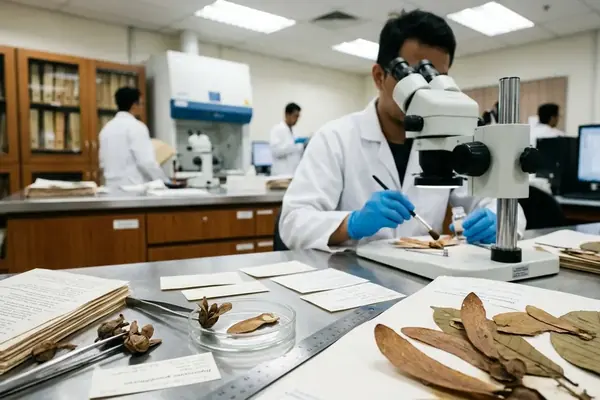
No claim survives without a physical voucher. Every plant cited in a study should correspond to a pressed, labeled specimen archived in a recognized herbarium, where future researchers can verify the identification independently. During the study, voucher specimens were deposited within about 48 hours of collection — a discipline that matters because tropical material degrades fast and a delayed press yields a determination nobody can confirm.
Linguistic Accuracy
Recording vernacular names correctly is not a courtesy. It is data integrity. A mistranscribed name severs the link between a specimen and the cultural knowledge attached to it, and that link cannot be rebuilt after the field season closes.
A voucher specimen without an accurate vernacular name is half a record; a name without a voucher is a rumor.
Scope and Limitations of Ethnobotanical Data
Ethnobotanical data carries a structural tension. Oral traditions are qualitative, contextual, and fluid; scientific publication demands the standardized and quantitative. Translating between these formats inevitably loses something.
Consider a healer's description of a remedy's strength relative to the season, the patient, and the moon. Compressed into a use-category and a frequency count, the nuance flattens. The number is reproducible. The meaning is partial. Researchers should report both, and they should be candid about the gap.
Critical Insight: One catch deserves emphasis. Data applicability decreases sharply when oral traditions span multiple language families without cross-verification. A use recorded in one dialect may not map cleanly onto a neighboring community's knowledge, and treating them as interchangeable introduces error that no statistical method recovers.
Ethics, Biopiracy, and Benefit-Sharing
The ethical boundaries of ethnobotanical research are not optional add-ons. When commercial value emerges from traditional knowledge, the question of who benefits becomes legal as well as moral. Biopiracy — the appropriation of indigenous knowledge or genetic resources without consent or compensation — has shaped how the modern discipline operates.
International instruments such as the Nagoya Protocol govern access to genetic resources and set out how international frameworks govern the equitable sharing of benefits derived from those resources. Prior informed consent and clear benefit-sharing arrangements are now baseline expectations, not aspirations.
Risk Factor: Research that overlooks dialectal name variations in island communities risks attributing a use to the wrong group entirely, which corrupts both the science and the eventual benefit-sharing claim.
Conservation and Future Applications
Ethnobotanical records do practical conservation work. They map which species a community depends on, which are declining, and which traditional management practices have sustained a landscape for generations.
Records drawn from the Mekong basin illustrate the link directly. Practices documented across several field seasons captured customary harvesting rotations and protected-grove conventions that predate any formal reserve designation. These local systems often conserve biodiversity more effectively than imposed regulations, precisely because the community designed and enforces them.
Traditional Practice and Sustainable Farming
Traditional agricultural practices feed directly into modern sustainable farming models. Intercropping arrangements, seed-saving customs, and indigenous soil-management techniques represent field-tested solutions to problems that industrial agriculture is only now confronting.
Recommendation: When adapting traditional practices for wider use, document the local conditions alongside the technique. Practices differ between highland and lowland groups in the region, and a method optimized for a flooded valley may fail outright on a terraced slope.
The same archive holds value for climate adaptation. Communities maintaining diverse landrace crops preserve genetic variation — including drought-tolerant and flood-resilient varieties — that breeding programs may need as conditions shift. Ethnobotany helps identify these resilient varieties before they vanish along with the knowledge of how to grow them.
Summary
Ethnobotany bridges cultural heritage and botanical science. It begins with a definition Harshberger gave in 1895 and extends to voucher-linked documentation, ethical consent, and conservation strategy.
The discipline rests on accurate taxonomy, faithful linguistic recording, and physical specimens that make every claim verifiable. Its limitations are real — qualitative knowledge resists quantitative compression, and cross-language records demand verification rather than assumption.
- Every use record should anchor to a deposited voucher specimen in a recognized herbarium.
- Vernacular names carry ecological and cultural information that Latin binomials omit; record them precisely.
- Ethical practice, including prior informed consent and benefit-sharing, is foundational, not supplementary.
- Traditional ecological knowledge informs conservation, sustainable farming, and climate adaptation in concrete ways.
The work remains, at its core, a race against time. Documenting traditional plant knowledge ethically and rigorously preserves a heritage that no herbarium alone can replace.
Citations
- The Nagoya Protocol on Access and Benefit-sharing — Secretariat of the Convention on Biological Diversity, 2011.
- Ethnobotany: Evolution of a Discipline, Society for Economic Botany, 1995.
- Methodology in Ethnobotanical Research, Journal of Ethnobiology, 2001.