Quick Nav
- The Intersection of Urban Commerce and Botany
- Capturing Agricultural Diversity in Cho Dong Xuan
- Collaborative Ethnobotanical Methodology
- Taxonomic Identification of Fruits and Principal Cereals
- Vegetables, Cash Crops, and Medicinal Variants
- Scope and Limitations of the Market Survey
- Implications for Plant Genetic Conservation
The Intersection of Urban Commerce and Botany
When the PROSEA Board of Trustees convened in Hanoi in November 1998, the schedule left a narrow window between formal sessions. That window became a market survey. Urban markets are not usually treated as research sites for plant genetic resources, yet they concentrate, in a single dense space, the agricultural output of an entire region.
A market vendor's stall is a working sample of what farmers in the surrounding provinces choose to grow, harvest, and sell. The cultivars that arrive there have already passed a set of filters: they keep through transport, they fetch a price, and consumers recognize them. For an ethnobotanist, this is a rapid, if incomplete, census of regional economic botany.
The objective of the survey was modest and specific. It set out to document the species and cultivars circulating through Hanoi's commercial food trade, linking common market produce to formal taxonomic identity. What follows summarizes that effort and its constraints.
Capturing Agricultural Diversity in Cho Dong Xuan
Cho Dong Xuan is among the largest and most complex market environments in Hanoi. Its scale is precisely what makes it valuable and what makes it difficult to read. Goods move quickly. A stall's inventory at nine in the morning differs from its inventory at noon, and the produce on display today may have travelled from any of several provinces.
Tracking the origin of a basket of yams or a stack of pomelos is rarely straightforward. Vendors buy from wholesalers who buy from intermediate traders who source from dispersed smallholders. By the time a fruit reaches the urban stall, its provenance has often been flattened into a price and a name.
This is where the formal record thins out. Cultivated staples are documented well enough in agricultural literature, but wild food plants and localized cultivars entering the city tend to slip past systematic taxonomy. They are sold under regional names, identified by appearance and use rather than by binomial, and they do not always appear in the standard references. The market survey was an attempt to narrow that documentation gap, at least for one moment in time.
Collaborative Ethnobotanical Methodology
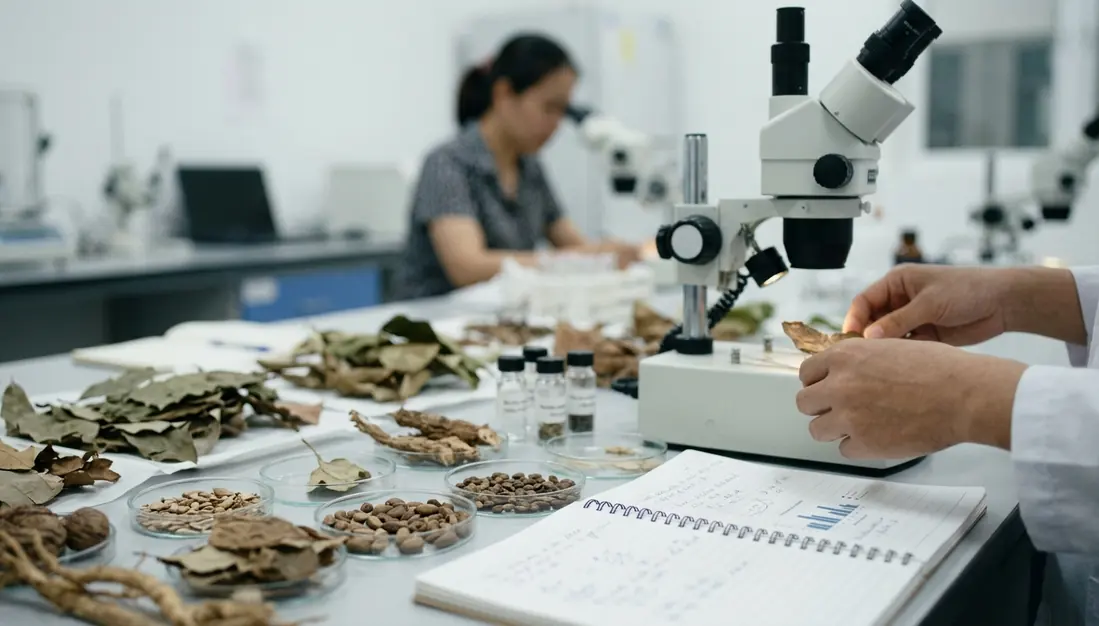
The survey worked because it relied on local botanical authority rather than outside guesswork. Prof. La Dinh Moi, of the Institute of Ecology and Biological Resources (IEBR), served as the primary guide. His familiarity with Vietnamese flora and with regional naming conventions allowed identifications to be made on the spot, in front of the produce, rather than reconstructed afterward from photographs and notes.
Jonathan Robinson, representing the Department for International Development Cooperation (DIDC) of Finland, joined the survey party, situating the exercise within a wider development-cooperation context concerned with plant genetic resources.
Categorizing by Plant Type
After initial walkthroughs to map the vendor clusters, the team chose to categorize stalls by plant type rather than by vendor or location. This structure prioritized direct observation over secondary trader interviews. The reasoning was practical: a botanist standing at a stall of leafy greens can verify identity directly, while a trader's account of where a crop came from introduces a chain of uncertainty.
The methodology favored what could be confirmed in hand. That choice shaped both the strengths and the boundaries of the resulting dataset, since identification by local naming convention varies between regions and a name recorded in Hanoi may not match the same plant elsewhere in Vietnam.
Results: Taxonomic Identification of Fruits and Principal Cereals
Oryza sativa was recorded as the dominant cereal, which surprises no one familiar with Vietnamese diets. Rice anchors the local food system, and its presence across the market reflected that centrality rather than any quirk of the survey window.
The fruit stalls offered a broader cross-section. Among the species identified:
- Pomelo (Citrus maxima) — the large yellow variety, prominent and easy to confirm.
- Dragon fruit (Hylocereus undatus), a cactus fruit increasingly traded through urban markets.
- Persimmon (Diospyros kaki).
- Sapodilla (Manilkara zapota).
- Several banana forms within the Musa genus, sold under distinct local names.
The banana entries illustrate the naming problem cleanly. What the market treats as several different products may, taxonomically, collapse into closely related cultivars, while the reverse can also occur. Recording both the local name and the botanical identification preserved information that either alone would have lost.
Results: Vegetables, Cash Crops, and Medicinal Variants
The vegetable stalls carried both cultivated greens and species that blur the line between weed and crop. Purslane (Portulaca oleracea) appeared among the leafy vegetables — a plant grown deliberately in some contexts and gathered as a wild food in others.
Root crops were represented by the yam Dioscorea esculenta, one of the species whose localized cultivars are easily underdocumented because they reach the city under vernacular names.
Cash Crops and Tea Variants
Beyond food for direct consumption, the survey noted cash crops moving through the same commercial channels. Sugarcane (Saccharum officinarum) was present, sold both as a raw commodity and processed.
Tea drew particular attention. The survey recorded distinct variants of the tea plant, Camellia sinensis — the small-leaved var. bohea and the broader-leaved var. assamica. Their co-occurrence in a single market underlines how urban commerce aggregates material from agroecological zones that rarely overlap in the field.
Interpretive point: An urban market compresses the output of multiple growing regions into one observable space. That compression is the survey's chief value and, simultaneously, the reason provenance data must be treated with caution.
Scope and Limitations of the Market Survey
The survey represents a single November 1998 observation window. That fact governs every conclusion drawn from it.
Market availability is highly seasonal. Species that were out of season in late November were simply absent from the stalls, and their absence in the record says nothing about their presence in the regional flora. The data reflect only goods offered for sale during the survey dates.
Limitation: Treating a market inventory as a regional species list will systematically undercount rare cultivars. Market surveys miss rare cultivars that are not sold in urban centers, and they overrepresent crops that travel and store well.
There is also a structural gap between commerce and subsistence. Urban market data may not reflect rural subsistence farming, where households grow varieties never intended for sale, nor the highly localized medicinal plant use that stays within villages and never reaches a city stall. The survey documents what the city buys, not what the countryside grows.
Recommendation: Pair any urban market survey with at least one rural field component when the goal is conservation assessment rather than commercial documentation. The two datasets answer different questions.
Conclusion: Implications for Plant Genetic Conservation
Within its limits, the Hanoi survey contributes a useful slice of Southeast Asian economic botany. It records which species command commercial demand, which cultivars travel into the capital, and how local naming maps onto formal taxonomy at one point in time. Each of these is a small but durable data point for anyone studying the region's plant genetic resources.
The findings were disseminated formally in the 1999 issue of the Plant Genetic Resources Newsletter, placing a brief, dated snapshot into the published record where later researchers can compare it against subsequent surveys.
The broader lesson is procedural. Urban markets deserve regular attention from botanists and agricultural researchers, not because they capture everything, but because they capture it quickly and visibly. A market changes faster than a field, and watching those changes over time can flag shifts in cultivation, demand, and the quiet disappearance of cultivars that simply stop arriving at the stalls.