Quick Nav
- Introduction to Southeast Asian Plant Genetic Resources
- The Role of Genebanks in Regional Conservation
- Comparing Methodologies: Seed Vaults vs. Field Genebanks
- Evaluating Key Regional Facilities and Focus Areas
- Scope and Limitations of Current Conservation Efforts
- Data Management and Taxonomic Standardization
- Conclusion and Future Directions
Introduction to Southeast Asian Plant Genetic Resources
Plant Genetic Resources (PGR) form the biological foundation of global agricultural resilience. Southeast Asia functions as a primary center of diversity for major crops and their wild relatives. Historically, in situ conservation served as the default mechanism for preserving this botanical diversity. Rapid habitat conversion and shifting monsoon patterns now threaten these natural reservoirs. Robust ex situ conservation strategies are required to secure these genetic assets before they disappear from their native ranges.
The Role of Genebanks in Regional Conservation
Genebanks safeguard genetic diversity by isolating germplasm from immediate environmental threats. Collaborative networks across ASEAN nations facilitate systematic germplasm exchange and duplicate storage. This regional cooperation aligns directly with frameworks such as the International Treaty on Plant Genetic Resources for Food and Agriculture. Formal conservation strategies increasingly integrate traditional ethnobotanical knowledge during the collection phase. Such integration ensures that economically and culturally significant accessions receive appropriate prioritization in storage queues.
Comparing Methodologies: Seed Vaults vs. Field Genebanks
Decisions regarding conservation infrastructure center on contrasting storage viability for different seed types after reviewing regional crop profiles. Orthodox seeds undergo controlled desiccation and are maintained at approximately -18°C for long-term storage. Experimental data indicates regeneration intervals of 8-12 years for rice accessions under these specific thermal conditions. This predictable cycle allows for highly efficient space utilization.
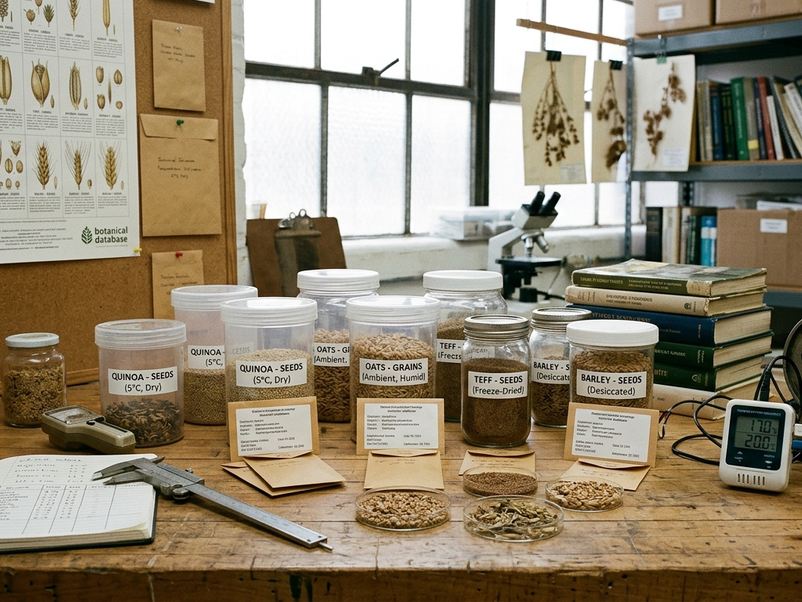
Recalcitrant seeds present a fundamentally different physiological challenge. Species including tropical fruits like mango and durian cannot survive freezing or severe desiccation. These taxa require active field genebanks. Field collections demand continuous land management, pest control, and irrigation. Does the resource intensity of living collections justify their inherent vulnerability to abiotic stress compared to climate-controlled indoor vaults? For recalcitrant species, no viable alternative currently exists at scale.
Recommendation: Institutions managing recalcitrant species should establish geographically separated duplicate field sites to mitigate the risk of localized pathogen outbreaks.
Evaluating Key Regional Facilities and Focus Areas
The International Rice Research Institute (IRRI) in the Philippines operates as a highly specialized global hub. Its infrastructure supports automated sorting and massive throughput for a single genus. National facilities in Malaysia, Thailand, and Indonesia prioritize a broader spectrum of indigenous crops and wild relatives. The Indonesian Institute of Sciences (LIPI) manages extensive collections that reflect the archipelago's distinct ecological zones.
Infrastructure and funding models diverge significantly between these tiers. International facilities often maintain standardized, single-crop focus areas with dedicated international backing. National genebanks must balance limited resources across complex, multi-taxa mandates—a challenge rarely faced by single-crop international hubs.
Scope and Limitations of Current Conservation Efforts
Initial conservation models assumed uniform seed behavior across geographic origins. Subsequent viability testing revealed significant environmental dependencies. Highland-region collections show different viability patterns; viability varies with local humidity levels prior to collection. Standardized drying protocols often fail when applied to these specific ecotypes.

Beyond these physiological barriers, coverage remains incomplete for certain wild relatives in remote areas. Logistical constraints prevent systematic sampling in dense, inaccessible terrain. Field genebanks also experience high mortality rates during extreme weather events. Genetic drift during seed regeneration presents an ongoing biological limitation for orthodox collections, as each grow-out cycle subtly alters the population genetics of the accession.
Risk Factor: Repeated regeneration of cross-pollinated species in environments differing from their native habitat accelerates genetic drift, potentially eliminating the exact adaptive traits the genebank intends to preserve.
Data Management and Taxonomic Standardization
Passport data and standardized taxonomic classification determine the ultimate utility of any genebank accession. The adoption of proven database architectures, such as GRIN-Global, varies widely across Southeast Asian facilities. Digitizing legacy botanical records presents a persistent operational hurdle. Inconsistent taxonomic standardization complicates regional germplasm exchange and delays research timelines.
Accurate data management ensures that breeders can identify and request specific genetic traits for crop improvement programs. Physical seeds hold little value without the corresponding metadata detailing their provenance, collection environment, and phenotypic characteristics.
Critical Insight: Without standardized passport data, physical seed collections function as isolated archives rather than active research assets.
Conclusion and Future Directions
The Southeast Asian genebank network demonstrates vital capacity in safeguarding staple crop diversity. National facilities excel in preserving indigenous cultivars, while international hubs provide critical infrastructure for major commodities. Ongoing partnerships, such as those supported by the Netherlands Ministry of Foreign Affairs since about 2015, provide essential funding for technical capacity building.
Future technological integrations must address the limitations of current storage methods. Cryopreservation offers a potential pathway for recalcitrant species, suspending cellular activity in liquid nitrogen. The optimal strategy requires a hybrid approach combining seed vaults, field collections, and advanced cryo-techniques, though viability metrics remain highly species-dependent.