Why Outplanted Shorea Seedlings Stall in Degraded Soils
In a sun-baked Kalimantan forestry nursery, rows of Shorea seedlings sit in sterile black polybags with pale, chlorotic leaf laminas and pinched, woody root collars. Daily overhead irrigation keeps the potting medium wet to the bottom of the bag. Standard nursery management assumes that consistent moisture and balanced soluble macronutrients will push dipterocarp wildlings through the hardening phase and prepare them for field establishment. When these uncolonized trees are lifted and set out into post-logging Imperata cylindrica grasslands, shoot elongation stops within weeks and foliar dieback follows.
Root excavations along those stalled planting lines show where that assumption breaks down. The fine lateral roots remain hairless, suberized, and confined to the original cylinder of nursery substrate, refusing to cross into the surrounding mineral soil. Heavy timber extraction and repeated grassland fires strip the native organic horizon from these sites, leaving compacted subsoil devoid of indigenous fungal propagules. Even when field crews apply soluble nitrogen-phosphorus-potassium dressings directly into the planting hole, the trees fail to initiate new flush growth.
Members of the Dipterocarpaceae have an obligate dependency on ectomycorrhizal (ECM) fungi throughout their life cycle, a foundational premise in the economic botany and silviculture of Southeast Asian timber production. In weathered tropical soils, inorganic phosphorus binds tightly to iron and aluminum oxides, rendering it inaccessible to bare dipterocarp root tips. Broadcast chemical fertilizers wash past the stunted root collar or fix immediately onto clay surfaces because the seedling lacks the living mycelial surface area required to intercept ions and mobilize organic nutrient pools. Without an intact fungal partner assembled before the polybag leaves the nursery bench, the outplanted tree starves in fertilized earth.
Anatomy of Dipterocarp Ectomycorrhizal Associations
Dissecting a healthy, colonized Shorea root system reveals three distinct structural zones working in sequence:
- The Fungal Mantle (Sheath): A dense, woven jacket of hyphae completely encases the short, swollen lateral root tips, suppressing root hair development and isolating the host epidermis from direct contact with bulk soil.
- The Intercellular Hartig Net: Hyphae penetrate inward from the inner mantle wall to form a labyrinthine network between the cells of the root epidermis and outer cortex, stopping cleanly before the endodermis.
- The Extraradical Mycelium: Individual hyphae and aggregated rhizomorphs radiate outward from the mantle into the surrounding soil matrix, extending well beyond the depletion zone of the woody root cylinder.
These three structures explain how the symbiosis bridges the nutrient gap in tropical forestry & agroforestry systems. As an angiosperm host family, Dipterocarpaceae restrict the Hartig net to the epidermal layer and outermost cortical cells, creating a high-surface-area apoplastic interface. Photosynthate carbon fixed in the Shorea canopy travels down the phloem and crosses this interface to feed the fungal partner. In the opposite direction, the extraradical mycelium secretes extracellular phosphatases and organic acids that cleave immobilized phosphorus and organic nitrogen from recalcitrant litter and mineral surfaces, funneling those nutrients back through the mantle and across the Hartig net into the host vascular stream.
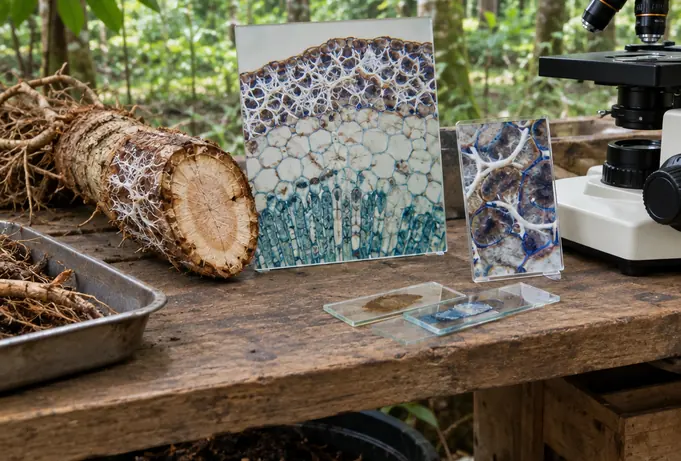
The physical architecture of the mantle does more than trade carbon for phosphorus. That tightly packed hyphal sheath acts as a mechanical and biochemical barrier against soil-borne oomycetes such as Phytophthora and Pythium, which routinely rot uncolonized feeder roots in wet polybag substrates. During seasonal drought stress in tropical wet-dry climates, the hydrophilic polysaccharides within the fungal mantle retain moisture around the active root tip and maintain hydraulic continuity across shrinking soil pores after bare lateral roots have desiccated.
Matching Fungal Taxa to Southeast Asian Timber Species
Early plantation trials across the region often treated ectomycorrhizal inoculation as a generic amendment, importing commercial fungal packets developed for temperate pines or applying a single lab strain across every site. Those efforts left a critical question unsettled: why do certain inoculants form vigorous sheaths in the nursery shade house only to disappear after outplanting on degraded tropical soils? The operational answer requires splitting candidate fungi by both stand succession stage and edaphic chemistry across regional flora.
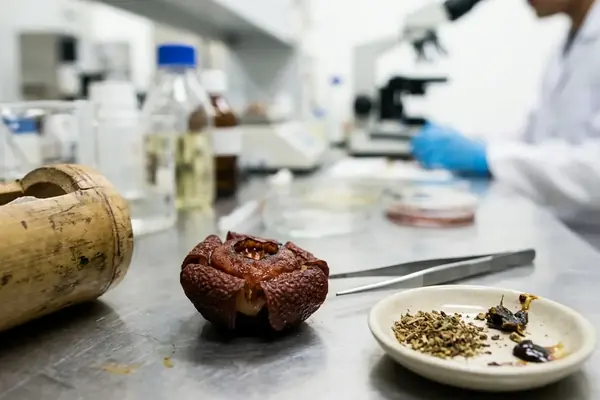
Pioneer gasteromycetes—specifically puffball and earthball taxa such as Pisolithus tinctorius and Scleroderma columnare—thrive in warm, exposed, and physically disturbed substrates. Their thick-walled basidiospores tolerate heat fluctuations in black polybags and rapidly colonize young root tips under high light regimes. By contrast, closed-canopy dipterocarp forests are dominated by late-stage basidiomycetes from the genera Russula, Lactarius, Amanita, and Boletus. These forest-interior guilds require cool, shaded organic horizons and continuous carbohydrate supply from mature canopy trees; when introduced into warm, mineral nursery media, their vegetative mycelia quickly senesce.
Selecting a functional partner for major timber species—including Shorea leprosula, Shorea parvifolia, and Shorea selanica—therefore centers on harvesting local gasteroid fungi whose dense spore masses can be gathered in bulk from remnant forest edges. As documented in the FAO Dipterocarps of South Asia review, reproductive phenology and site matching govern artificial regeneration success across the family. Isolating indigenous Scleroderma and Pisolithus ecotypes directly from acidic, aluminum-rich tropical Ultisols and Oxisols ensures that the extraradical mycelium can tolerate high exchangeable aluminum levels once planted into stripped grassland pits. While a pioneer Scleroderma or Pisolithus inoculum can occupy disturbed nursery media and propagule-poor Imperata ground, it does not install the late-stage Russula–Lactarius–Amanita–Boletus guild of closed canopy, and a non-native commercial strain taken off a non-acidic soil fails to establish on aluminum-rich Ultisols and Oxisols.
Nursery Inoculation Methods: Soil, Spores, and Vegetative Mycelium
Operational nurseries rely on three primary delivery vectors to introduce ectomycorrhizal fungi into dipterocarp production lines, each carrying distinct logistical and phytosanitary trade-offs.
- Wild Forest Topsoil Transfer: Mixing five to ten percent surface soil dug from beneath mature dipterocarp mother trees directly into the nursery potting medium introduces a diverse suite of native propagules, including sheared mycorrhizal root tips and sclerotia. However, hauling tons of topsoil from remnant stands is labor-intensive, damages the donor forest floor, and routinely imports parasitic nematodes and damping-off oomycetes into the nursery bench.
- Basidiospore Slurries and Compressed Tablets: Harvesting mature fruiting bodies of local Scleroderma and Pisolithus puffballs yields concentrated hydrophobic spore powders that can be blended into aqueous drenches or pressed into clay carrier tablets placed beneath the root collar. This vector is lightweight, stores well at ambient shade temperatures for short intervals, and scales easily across tens of thousands of polybags.
- Axenic Vegetative Mycelium on Peat-Vermiculite Carriers: Pure fungal cultures grown under sterile laboratory conditions in flasks of peat moss and vermiculite moistened with nutrient broth provide pathogen-free inoculum of a verified physiological strain. The trade-off is high unit cost, slow mycelial growth in culture, and rapid loss of viability if the carrier overheats during field transport.
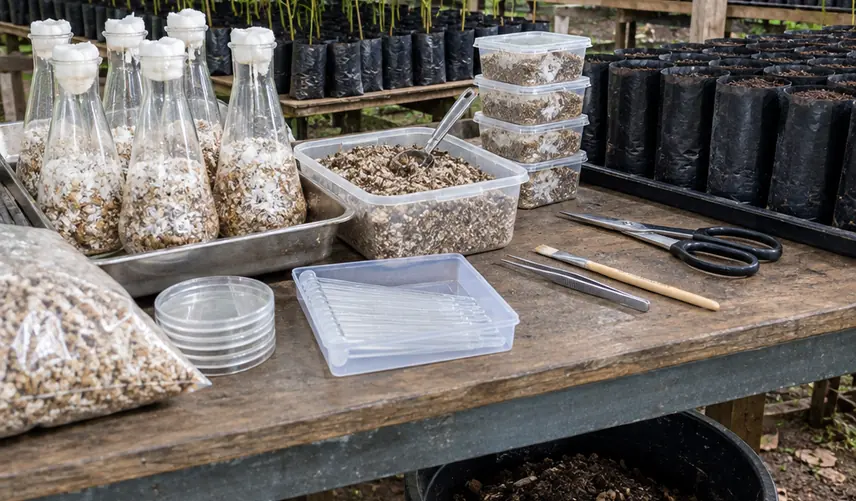
Substrate Aeration and Phosphorus Restriction
Regardless of which inoculation vector a nursery selects, potting medium chemistry dictates whether hyphae actually infect the lateral roots. Heavy clay topsoils compact inside polybags under daily watering, creating hypoxic pockets that suffocate aerobic ectomycorrhizal mycelium. Blending burnt rice husks or washed cocopeat into the mineral soil keeps macro-pore aeration open down the full depth of the container.
Withhold Soluble Phosphorus Dressings: High concentrations of soluble orthophosphate in the potting substrate suppress the host plant's strigolactone and exudate signaling pathways, causing Shorea roots to reject fungal entry even when viable spores coat the epidermis. Restrict soluble phosphorus applications during the colonization window so the seedling actively recruits its symbiont.
Morphological Clearance Before Outplanting
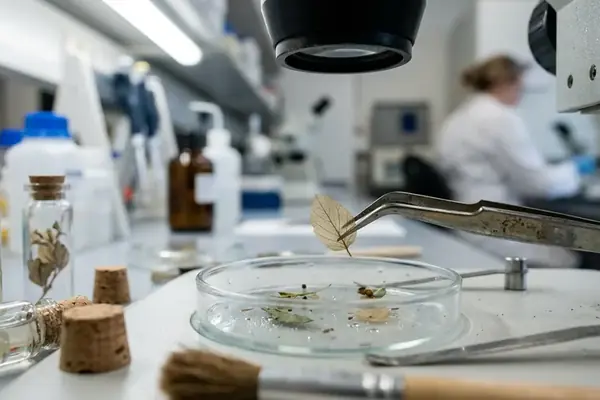
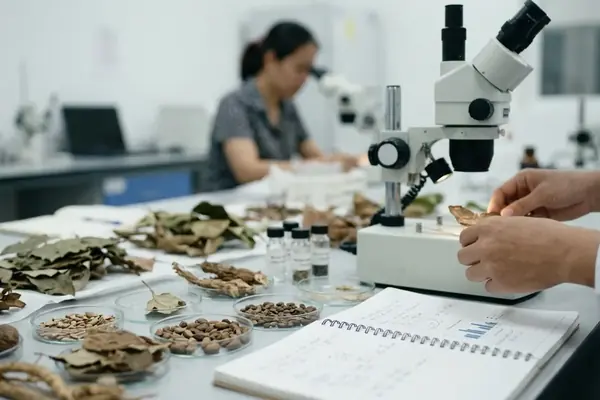
Seedlings must never be cleared for field transport based on shoot height alone. Prior to lifting a batch, nursery technicians wash a destructive sample of root systems over a fine mesh screen and examine the lateral tips under a dissecting microscope. Certified clearance for outplanting into degraded Imperata ground requires clear morphological verification: abundant dichotomous or coralloid branching of short lateral roots encased in a continuous golden-brown or white hyphal sheath, with radiating extraradical strands visible against the dark substrate particles.
Step-by-Step Protocol: Inoculating a Shorea leprosula Nursery Batch
To execute a spore-drench inoculation program on a production batch of Shorea leprosula destined for compacted Ultisol grassland, run the nursery cycle through the following four-month sequence.
- Harvest Basidiocarps at Rainy-Season Onset: Walk the drip line beneath remnant mature Shorea mother trees during the first weeks of the rainy season and collect firm, mature Scleroderma fruiting bodies before the peridium ruptures and wind disperses the gleba.
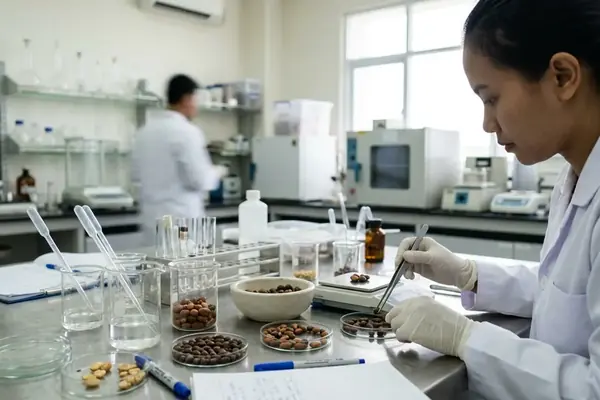
- Process and Sieve the Spore Mass: Air-dry the collected basidiocarps on shaded paper trays for forty-eight hours, crush the brittle peridia by hand, and pass the dark brown glebal powder through a stainless-steel soil sieve to remove coarse wall fragments and forest debris.
- Prepare the Non-Chlorinated Spore Suspension: Suspend the sieved basidiospore powder in clean, non-chlorinated well water or rainwater inside a glass beaker, adding a drop of non-ionic surfactant if needed to break the surface tension of the hydrophobic spores; chlorinated tap water will kill basidiospores on contact.
- Drench Weaned Cuttings or Wildlings: Select weaned Shorea leprosula stem cuttings or germinated wildlings already potted into perforated black polybags filled with a low-phosphorus mix of forest subsoil and burnt rice husks. Pour a measured dose of the stirred spore suspension directly into dibble holes around the root zone of each seedling, then water lightly with non-chlorinated water to wash the spores down onto the unsuberized lateral root tips.
- Maintain Shade and Inspect Mantle Formation (Weeks 1–10): Hold the inoculated batch under nursery shade cloth while keeping soluble phosphorus off the irrigation schedule. At week ten, wash out representative root systems and verify under a dissecting microscope that golden-brown Scleroderma mantles and dichotomous branching have established across the feeder roots.
- Harden Under Stepped Light Regimes (Weeks 11–16): Once mantle formation is confirmed, progressively pull back the shade cloth over the final six weeks of the four-month (sixteen-week) nursery interval. Stepping up light intensity drives higher photosynthetic rates in the Shorea leprosula canopy, sending a surge of photosynthate carbon down to thicken the Hartig net and expand the extraradical mycelial web throughout the polybag cylinder.
- Root-Intact Field Planting: In this Shorea leprosula example, the hardened seedlings reach the prepared Ultisol pits with their root balls intact. The black polybag is slit and peeled away without crumbling the burnt-rice-husk and soil core. Setting that intact core into the pit preserves the nascent extraradical network as it begins foraging into the surrounding Ultisol.