When the dipterocarp canopy closes over manau rattan
A slender Calamus manan beneath a sealed dipterocarp canopy can look like a plant losing ground. Its stem is narrow, and little of its recent growth has gone into girth. The expected explanation is suppressed growth. The more useful question is where that growth has gone.
In the Malay Peninsula’s mixed dipterocarp understorey, the transition can be followed from the late dry-season overstorey flush into the first wet-season months, as the canopy reseals. Read the stem alongside its newest leaves: a longer axis and developing climbing organs suggest a plant directing growth toward a route into the light. This reading holds most clearly when the observer can follow a solitary plant from its rosette through the first climbing leaves.
Canopy closure therefore acts as a developmental cue for manau rattan. The understorey stem has a job to do before it can build a substantial cane: reach support. Calling it stunted on stature alone obscures that sequence.
What longer internodes and thinner stems reveal
The field readings sit together: lower understorey light, longer internodes through the juvenile-to-climbing transition, and less immediate increase in stem girth. Taken separately, a long internode might be dismissed as an odd growth increment. Along a shaded axis, the pattern points to rapid vertical extension while diameter growth waits.
Follow consecutive internodes rather than selecting the longest one. Record their lengths in order from the last rosette leaves, then note whether the stem maintains or gains diameter. This makes the developmental shift visible without treating every narrow stem as the same phenomenon. Intercalary growth extends the axis; resources committed to that extension are temporarily unavailable for girth.
Where the stem reading holds
In primary mixed dipterocarp forest, light conditions give this internode-and-girth pattern a useful context. Nutrient-stripped, heavily degraded soils complicate it. A thin stem there may reflect poor nutrition even where shade is modest, so internode length cannot carry a yield prediction from a primary-forest plot onto logged ground. Record soil condition before using stem form to infer a response to canopy closure.
The practical distinction matters in a planting survey. A shaded seedling with extending internodes may be searching for a trunk; a similarly thin seedling on degraded soil provides weaker evidence of that climbing transition. Canopy and substrate observations belong on the same field sheet.
How the last rosette frond gives way to a cirrus
Stem measurements leave one question open: what, exactly, is the extending rattan preparing to do when it reaches a tree? The leaves answer it. Start at the last fully expanded rosette frond, with its broad photosynthetic surface, and examine the leaves produced immediately afterward. Their lamina area diminishes as the rachis extends into a cirrus, the whip-like organ that helps the cane climb.
Low light is associated with earlier cirrus development, yet the neighbouring trunk is part of the field explanation too. Its surface provides the trellis on which the grapnel hooks complete their climbing form. Look for both conditions—reduced light and an accessible support, before interpreting a young leaf as evidence of a settled climbing habit.
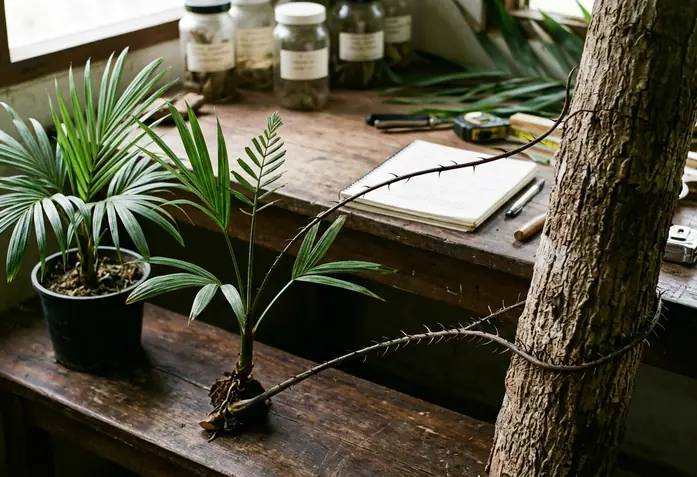
A broad rosette frond and a cirrus-bearing leaf may occur on the same plant. That sequence is especially valuable because it ties the changing leaves to one axis. Photograph the leaf bases and rachis in order, and keep the position of the nearest support tree in the frame or field notes. A detached leaf alone loses much of the evidence.
Keeping shade forms within Calamus manan
Long internodes and reduced stature can make a shade-grown manau rattan appear to belong to a smaller species. Identification improves when the observer separates characters that respond strongly to light from those used to diagnose the plant. For this field comparison, give less weight to apparent stature and internode length. Check the solitary habit, the presence of a cirrus rather than a flagellum, and the sheath armature.
Those characters require a complete observation. A young stem without a clear view of its leaf extensions can leave the cirrus question unresolved; an isolated length of cane gives no reliable view of habit. Trace the axis back to its base where access permits, inspect the sheath, and record the most mature climbing leaf available. Keep the tentative name attached to a voucher-backed record rather than turning an unusually slender stem into a new field taxon.
Then cross-check the identification against canopy density at the collection point. A closed canopy makes a shade morphotype plausible, while an open position calls for a closer look at the specimen and its growing conditions. This canopy check supports morphological identification; it cannot replace the diagnostic characters.
Mapping canopy closure before placing manau rattan
For a planting plot, make the canopy assessment in one circuit before marking positions. The aim is to link each prospective cane to both its light environment and a reachable support tree. Use the same field route when later observations are made, so a change in internode growth can be compared with the original shade profile.
A plot circuit and an elongation estimate
- Map the supports. Mark existing tree trunks that a developing cirrus could reach. Note light gaps and the parts of the plot beneath continuous crown cover.
- Record closure. Use a spherical densiometer observed at approximately 1.3 m at the plot centre and four cardinal offsets. Record the closure percentage at each station and retain the individual readings; a single plot-wide value would hide the gap beside a support tree.
- Project internode stretch. Compare the local shade profile with internode sequences on plants growing under comparable primary-forest canopy. Expect greater extension where light is lower. If repeated measurements are available, calculate an observed elongation rate as the change in internode length divided by the elapsed observation interval. Without those measurements, record the expected direction of change rather than assigning a numerical rate.
- Mark planting positions. Allow wider spacing beneath dense canopy, where extending cirri could become entangled. In light gaps, closer spacing can accompany the slower vertical search and greater opportunity for cane girth to accumulate. Keep a mapped support within reach of each proposed position.
A planting decision at the canopy edge
Consider a primary-forest plot with continuous crowns over its centre and a light gap at its eastern edge. In one circuit, the surveyor maps a trunk beside the shaded centre and another beside the gap, then takes densiometer readings measured near 1.3 m at the centre and each cardinal offset. The readings establish which positions belong to the closed-canopy zone and which fall in the gap; the surveyor keeps the recorded percentages with the plot map.
Next, the surveyor compares internodes on existing plants in each zone and records the lengths for a repeat visit. The shaded plants show the longer-internode pattern, so the map marks greater expected extension there; a later length difference divided by the time between visits supplies the observed rate. Finally, the surveyor marks wider planting positions near the central support to leave room for cirri, and closer positions beside the eastern gap where girth can develop. Each marked position now has a canopy reading, a growth expectation, and a mapped trunk to climb.