Rethinking Orang Asli Rafflesia Harvesting
Conservation rules often classify every removal of a protected plant as the same ecological event. That legal simplification obscures a decisive biological distinction in Peninsular Malaysia: collecting a closed-bract Rafflesia bud for an Orang Asli postpartum decoction belongs to a different pressure ledger from felling the Tetrastigma host and converting the surrounding lowland dipterocarp forest.
The distinction matters because Rafflesia cannot be conserved apart from its host vine and forest environment. A prohibition focused narrowly on bud removal may leave the larger causes of population loss poorly represented. Logging and agricultural conversion remove host patches, alter forest conditions, and eliminate the places where future buds could develop. Traditional collection removes selected buds while leaving the host and surrounding forest in place.
Earlier treatments of this conflict left the ordering of those pressures unsettled. Indigenous use appeared under the legal category of exploitation, while habitat conversion appeared under land management. The present approach ranks drivers by ecological consequence. Lowland dipterocarp conversion comes first; regulated postpartum collection is then evaluated within the surviving host population.
Postpartum use within a living landscape
The ethnobotanical pathway is specific. Orang Asli harvesters collect certain Rafflesia buds for decoctions used during postpartum recovery. The practice depends on knowledge of host locations, bud development, access routes, and appropriate collection stages. That knowledge accumulates through repeated presence in the forest.
Repeated presence can support conservation when local councils participate in mapping, harvest rules, and population checks. Harvesters have a direct reason to keep host vines standing and to watch known patches over time. Their observations can reveal bud emergence, damaged vines, forest intrusion, and collection by outsiders well before an occasional botanical survey reaches the same site.
Separate The Pressures
Record bud collection, host-vine loss, canopy disturbance, and land conversion as separate events. Combining them under a single exploitation label conceals which action removed reproductive potential and which action removed the entire habitat.
Friction arises because state biodiversity mandates commonly treat indigenous removal from protected forest as an offence. The legal boundary may therefore criminalise a small, culturally regulated harvest while giving little formal standing to the stewardship associated with it. A joint conservation frame changes the unit of assessment. It examines the host patch, the remaining buds, the reproductive plants, and the continuity of Orang Asli oversight.
This framing does not presume that every traditional collection is harmless. It provides a testable basis for deciding which collections can remain compatible with protection.
Drawing the Boundary Between Use and Population Loss
The initial expectation was straightforward: if postpartum harvesting drove Rafflesia decline, records should show collection removing buds broadly enough to compromise reproduction across occupied host patches. That expectation was checked by pairing harvest intensity with evidence of habitat loss instead of examining collected buds in isolation.
The comparison held at the level where it mattered. Harvest records concerned selected stages on surviving Tetrastigma hosts. Logging and agricultural conversion affected the host vines and their forest setting. These pressures differ in duration, spatial extent, and reversibility, even when conservation law records both through the language of protected-species damage.
A narrowly defined medicinal pathway
Medicinal demand was limited to the documented postpartum decoction pathway. Expanding the category to all folk medicine, plant trade, or ceremonial use would make the assessment less precise. The relevant question is whether bud collection for this preparation removes enough developing flowers to disrupt reproduction on the host patches being used.
The biochemical claim also requires discipline. The sought property is the recovery effect attributed to the prepared decoction within Orang Asli practice. Documentation at the camp hearth can record the plant part, developmental state, preparation sequence, and route of use. It cannot by itself identify active compounds or establish clinical efficacy. Decoction chemistry and pharmacological validation require different evidence from an ethnobotanical harvest record.
That boundary protects two kinds of accuracy. It preserves the reported medicinal purpose without converting community testimony into a laboratory result, and it prevents a chemical question from displacing the immediate conservation question of how many buds remain on a viable host.
One offence, unequal ecological consequences
Peninsular conservation rules presently criminalise indigenous removal of Rafflesia from protected forest. In practice, a closed-bract bud taken for a postpartum preparation can enter the same legal category as destructive removal. The statute records possession or removal; the population assessment must record what happened to the host, neighbouring buds, and reproductive opportunity.
A defensible scope therefore separates four observations:
- Harvest object: the developmental stage and condition of the selected bud.
- Host condition: whether the Tetrastigma vine remains rooted, intact, and associated with other buds.
- Patch condition: canopy disturbance, cutting, conversion, or access changes around the host.
- Reproductive continuity: whether remaining buds proceed toward anthesis during subsequent checks.
These observations make traditional use comparable with habitat loss without pretending that the two pressures operate in the same way. They also define the evidence needed before a harvesting restriction can be justified biologically rather than inferred solely from legal status.
Following a Bud from Host Vine to Camp Hearth
The field readings appear first as a sequence. A council grants access to an indigenous reserve. Ethnographic walks lead to known Tetrastigma patches in lowland dipterocarp forest. Botanical scoring records host and bud condition. A selected bud is followed from closed bracts through collection and preparation. The same host is then eligible for later checks of the buds left in place.
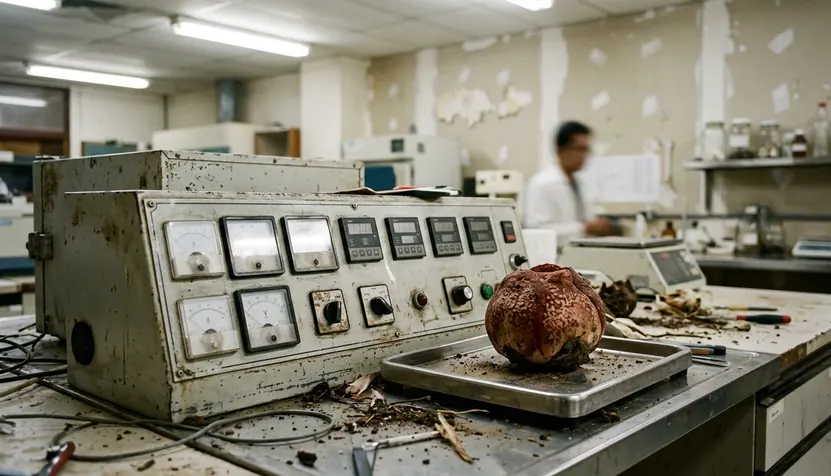
Seen together, those readings explain why a conventional grid census was poorly matched to the plant. Rafflesia follows an unscheduled blooming cycle, and bud development has been evaluated at approximately 6–12 months. Anthesis cannot be booked to coincide with a fixed survey visit. Concentrating effort on known host patches yields a more coherent account of selection and survival than laying out a systematic grid over forest where host occupancy remains uncertain.
Collaborative walks and botanical scoring
Each walk should begin with the boundaries agreed by the indigenous council. Participants identify permissible routes, culturally sensitive areas, known harvest zones, and spatial information that must remain restricted. The botanist records only the precision authorised through that agreement.
At a host patch, the botanical record should distinguish the vine from every visible Rafflesia structure associated with it. Bud stage, bract closure, visible damage, and the presence of other developing buds belong in separate fields. Photographs may support stage scoring where consent permits them, but a photograph cannot replace a host identifier and dated field note.
When collection occurs, the record follows the chosen bud. Selection criteria should be written in the harvester's terms before they are translated into a standard botanical field. This preserves distinctions that may otherwise disappear under broad labels such as immature or harvested. The preparation account is completed at the camp hearth, including the sequence by which the bud enters the postpartum decoction.
No Rafflesia disk, placenta, or seed leaves the protected stand for solvent extraction. That rule keeps viable reproductive material within the forest and prevents an ethnobotanical survey from becoming an unlicensed specimen-collection exercise.
Where the field record stops
Survey coverage was confined to lowland dipterocarp forest on indigenous reserves where councils granted access and collaborative mapping. Tetrastigma patches outside those reserves were not walked. The resulting record can describe the observed harvest system and its mapped host patches, but it cannot represent every Rafflesia population in Peninsular Malaysia.
Time imposes a second constraint. A single visit captures condition, not developmental outcome. Buds can remain closed across long intervals, disappear between visits, or reach anthesis outside the survey window. Host-vine tags therefore need repeated readings, with the interval and observer recorded consistently.
Respect Map Boundaries
Restricted coordinates should remain under the access terms set by the council. A precise public map can direct unauthorised collectors to the very host vines the survey was intended to protect.
Host-patch observations establish local trajectories, not a peninsula-wide population estimate. Within that scale, however, pairing ethnographic walks with botanical scoring captures the decision process that a detached flower count would miss.
Separating Postpartum Collection from Forest Conversion
The ecological ordering is clear. Logging and agricultural conversion remove habitat at a scale that traditional postpartum collection does not approach in the observed harvest records. Conversion can eliminate Tetrastigma hosts, alter the lowland dipterocarp canopy, and end the developmental sequence of every associated bud at once.
Traditional harvesting showed a selective pattern. Harvesters targeted particular bud stages and left reproductive plants on the same host. The relevant ecological unit was therefore a partially harvested host patch rather than an emptied population. Follow-up observation could ask whether the remaining buds persisted to anthesis and whether the host continued to support later development.
Selection as an observable rule
Selective harvest should be demonstrated through records, not assumed from the word traditional. A usable entry links the removed bud to a host identifier, lists the other buds present, records their stages, and schedules another reading. If the same host retains developing buds across visits, the evidence supports continuity. If repeated collection leaves no reproductive pathway, the same protocol exposes that pattern.
This design also distinguishes cultural regulation from commercial extraction. Orang Asli postpartum use has a defined preparation pathway and local social context. Commercial collection by non-indigenous actors may have different incentives, volumes, selection rules, and destinations. Combining both under a generic harvest total would erase the mechanism conservation managers need to address.
What exclusion zones can displace
Strict exclusion zones can produce an unintended enforcement gap. Cases in which traditional stewards were removed from familiar territories were followed by commercial collection by non-indigenous actors. The boundary remained on paper, while day-to-day observation inside the forest weakened.
Local access can provide a practical monitoring layer because known host patches are revisited for reasons embedded in community life. Removing that presence may reduce the chance that damaged vines, newly cut routes, or outsider collection are detected promptly. The conservation value lies in governed access: council agreements, mapped zones, stage-specific records, and repeated host checks.
A joint framework can therefore assess three outcomes at once:
- whether postpartum harvest leaves buds capable of reaching anthesis;
- whether host vines and surrounding forest remain intact;
- whether authorised local presence deters or documents outside collection.
These outcomes are stronger than a simple count of confiscated buds because they measure persistence. They also place enforcement effort closer to the dominant threat. A host patch cleared for agriculture cannot recover through a tighter rule on decoction preparation; its ecological foundation has already been removed.
Recording Protected Rafflesia Use Without Removing Specimens
Field documentation should proceed in a fixed order. Consent comes before coordinates, host-vine marking comes before harvest description, and preparation notes come last. Reversing that order risks disclosing sensitive sites or collecting protected material before the terms of access are understood.
Consent, mapping, and host monitoring
- Establish prior informed consent. Meet the relevant indigenous council before entering a harvest zone. Agree on the purpose of the record, who may see it, whether photographs are allowed, how observations will be returned, and which knowledge remains outside publication.
- Create a collaborative map. Mark only the zones the council authorises. Separate working coordinates from any public-facing description, and record the permitted spatial precision for each dataset.
- Assign a non-destructive host code. Apply a GPS-linked identifier to the Tetrastigma host without cutting, drilling, or removing tissue. Keep the public record general enough to protect the site.
- Score the complete host patch. Record the selected bud and all visible buds left on the vine. Include developmental stage, bract condition, visible damage, and surrounding disturbance.
- Document selection at the harvest site. Ask the harvester to describe why that bud was selected. Preserve the original category used by the participant alongside the botanical interpretation.
- Record preparation at the camp hearth. Describe the postpartum decoction pathway without carrying a disk, placenta, seed, or other viable material out of the protected stand.
- Schedule host-vine rereads. Revisit tags on an 8–14 week cycle and score whether remaining buds continue development or reach anthesis. Use the same host code and stage fields on every visit.
- Return the record. Provide the council with the agreed map and observations, including restricted details that should not enter an open biodiversity database.
The consent sequence aligns with the Convention on Biological Diversity guidelines on traditional knowledge. It also improves data quality. Participants can correct place names, distinguish harvest categories, and identify records whose disclosure would expose sensitive host patches.
A complete host-patch entry
Consider a field team entering a council-approved zone labelled Area A. The working map contains the coordinates, while the shareable record contains only the reserve and zone code. At the first known vine, the team assigns host code AREA-A-TV-01. No plant tissue is taken.
The recorder lists every visible Rafflesia bud under that host code. One closed-bract bud selected for postpartum decoction receives the event code H-01. The field note captures the harvester's selection description, the bud's botanical stage, the date, and the condition of the vine. Each unharvested bud receives its own suffix so later observations cannot be confused with the removed bud.
At the camp hearth, the recorder documents the preparation sequence and intended postpartum use. The entry states explicitly that no disk, placenta, seed, or solvent-extraction sample left the protected stand. Sensitive knowledge excluded by the consent agreement stays out of the database.
Before leaving, the team schedules the first reread eight weeks later, within the established 8–14 week monitoring cycle. On that visit, the observer opens AREA-A-TV-01, checks the condition of the host, scores each remaining bud, notes any canopy or access disturbance, and records whether any bud has reached anthesis. The council receives the updated host-patch sheet and restricted map. That single record now connects consent, authorised location, selective harvest, postpartum preparation, forest condition, and reproductive follow-up without removing a botanical specimen.