Quick Nav
- Introduction to Sugarcane Weed Competition
- The Challenge: Weed Interference
- Solution: Methodology and Herbicide Selection
- Results: Efficacy and Weed Suppression
- Impact on Sugarcane Growth and Final Yield
- Scope and Limitations
- Conclusion and Agronomic Best Practices
- Citations
Introduction to Sugarcane Weed Competition
Sugarcane underpins a substantial share of agricultural revenue across South-East Asia, supplying sugar, molasses, and an expanding bioethanol sector. Its long growth cycle and high biomass demand make it economically attractive, but those same traits leave it exposed to competition during the months when the canopy has yet to close.
The early tillering phase is the vulnerable window. A young crop with an open canopy cannot shade out fast-establishing weeds, and the carbohydrate reserves that drive tiller production are easily diverted toward survival rather than expansion. Once tiller density is suppressed, the deficit carries through to harvest.
This is why post-emergence weed control has to be timely rather than merely thorough. Intervene late, and the yield loss is already encoded in the stand. The question for the agronomist is narrow: which herbicides, applied when, hold the critical window open long enough for the crop to take command of the field.

The Challenge: Weed Interference in Sugarcane Cultivation
Two functional groups dominate the early competition. Sedges, led by Cyperus rotundus, and grasses such as Echinochloa spp. establish quickly and draw heavily on the same shallow nutrient pool the young cane depends on. Broadleaf weeds add a second front, competing for light as much as for soil resources.
How competition plays out below and above ground
Cyperus rotundus is the persistent problem. Its tuber network regenerates after foliage is removed, and it scavenges nitrogen and water with an efficiency that outpaces many cultivated species. Broadleaf weeds and grasses compete more visibly for sunlight, overtopping the seedling cane before the canopy can respond.
The economic consequence is rarely a single dramatic loss. It accumulates: reduced tiller counts, thinner stalks, and a harvest that demands more labour per recoverable tonne because operators work around weed-choked rows. Unmanaged proliferation degrades harvest efficiency long before it registers as an obvious yield figure.
Solution: Methodology and Herbicide Selection
Selection began with taxonomy. Herbicide choices were matched to the dominant weed groups present at scouting, then adjusted for the growth stage actually observed in the field rather than the stage assumed from a calendar. A product effective against broadleaf species offers little where sedges form the bulk of the infestation, and the reverse holds equally.
Application protocol
From replicated trials, applications were timed 20 to 30 days after crop emergence, placing the treatment within the early tillering window while target weeds remained at a susceptible growth stage. Spray volume was set at 250 litres per hectare, carrying approximately 0.2 percent non-ionic surfactant to improve leaf retention and uptake on waxy sedge foliage.
Equipment calibration
Calibration did not rely on manufacturer default tables. Nozzle output was tested on-site, and delivery rates were set from those measurements. The reason is practical — worn nozzles and field pressure variation routinely diverge from catalogue figures, and uniform coverage is the difference between suppression and a patchy escape population.
For broader framing of integrated approaches, the Food and Agriculture Organization guidelines on weed management provide a useful reference point against which site-specific protocols can be checked.
Results: Efficacy and Weed Suppression
Weed mortality following targeted application was visible within the first week, most rapidly among broadleaf species. Experimental data indicates a clear gradient in response: broadleaf weeds collapsed reliably, while persistent sedges required the surfactant-enhanced uptake to achieve meaningful knockdown.
Broadleaf weeds versus persistent sedges
Cyperus rotundus remained the hardest target. Foliar suppression was achieved, but the tuber bank limited the durability of control where regeneration potential was high. Grasses such as Echinochloa spp. sat between these extremes, responding well when treated at the younger growth stages.
Crop tolerance was the reassuring outcome. Across treated blocks, sugarcane stalks showed no phytotoxic symptoms — no leaf scorch, no stunting attributable to the herbicide rather than to residual competition. The selectivity held, which is the precondition for any post-emergence programme in a standing crop.
Impact on Sugarcane Growth and Final Yield
Early suppression and tiller production tracked together. Blocks cleared during the tillering window produced denser tiller stands than their weedy counterparts, and that density is the foundation on which stalk number — and ultimately recoverable yield, is built.
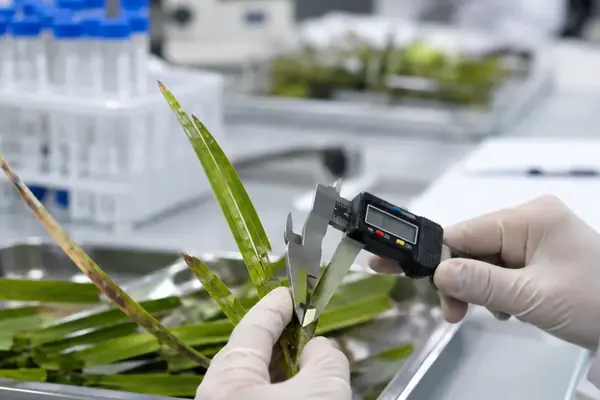
Growth measurements reinforced the pattern. Treated cane carried greater stalk height and girth, and biomass accumulation reflected the resources retained once competition was removed. The unmanaged control environments told the opposite story: thinner, shorter stalks and a stand that never recovered the ground lost in the first weeks.
Preserving the early tillering window is not a marginal gain. It is the single intervention that most directly determines whether the harvestable yield matches the crop's genetic potential.
The comparison with unmanaged plots makes the case without elaboration. Where weeds were left to proliferate, the yield penalty was already locked in by the time the canopy would otherwise have closed.
Scope and Limitations of Herbicide Application
These results are bounded by conditions that any practitioner should weigh before transferring the protocol.
Environmental dependencies
Efficacy declined when ambient temperature at spraying exceeded a threshold logged at about 34 °C. Heat stress alters herbicide uptake and can push the crop toward a more sensitive physiological state, so the application window narrows on the hottest afternoons. Soil moisture matters too — control failure was observed on compacted clay soils with poor infiltration, where neither soil-active movement nor healthy weed metabolism could be relied upon.
Resistance and persistent perennials
Repeated reliance on the same chemistry across successive seasons selects for resistant biotypes. This is a structural risk, not a hypothetical one, and it argues against treating any single herbicide as a permanent answer.
Late-emerging perennials remained the persistent gap. Response was variable when Cyperus rotundus tubers sat at depths sampled at around 8 cm or deeper, beyond the reach of foliar suppression — a reminder that perennial control depends on more than a well-timed spray.
Risk Factor: A protocol validated under moderate temperatures and well-drained soils should not be assumed to hold on compacted clay or during peak-heat application; both conditions degraded control in field observation.
Conclusion and Agronomic Best Practices
The critical window for post-emergence intervention is short and decisive. Treatment in the 20-to-30-day post-emergence band, matched to weed taxonomy and applied through properly calibrated equipment, preserved the tillering capacity that defines final yield.
Chemical control alone is insufficient over the long term. The durable approach integrates it with mechanical cultivation and cultural practices — stand vigour, row spacing, and timely scouting, that reduce the burden placed on any single herbicide and slow the selection of resistant weeds.
Recommendation: Rotate herbicide modes of action across seasons and pair each application with a non-chemical tactic, particularly where Cyperus rotundus is established. Schedule spraying for cooler periods to stay below the temperature threshold where uptake falters.
Critical Insight: Ongoing field monitoring is the practice that ties the rest together. The findings here reflect specific soil and climate conditions in South-East Asian sugarcane systems, and they should be re-validated locally before scaling — weed pressure shifts, and a protocol that worked last season is a hypothesis, not a guarantee, for the next.
Citations
- Weed Management in Sugarcane — Food and Agriculture Organization (FAO), 2018.
- Efficacy of Post-Emergence Herbicides, International Society of Sugar Cane Technologists, 2021.
- Taxonomy of Agricultural Weeds in South-East Asia, PROSEA Foundation Archives, 2019.